Improving resource sharing in fire and rescue services (BRACE)
BRACE develops a practical, data-driven framework for coordinating resources during large and concurrent incidents. It also develops a model that links nationwide assessments of natural hazard risk with the resource needs of fire and rescue services, enabling more objective decision-making on resource sharing between regions. The aim is to strengthen cooperation between fire services during crises.
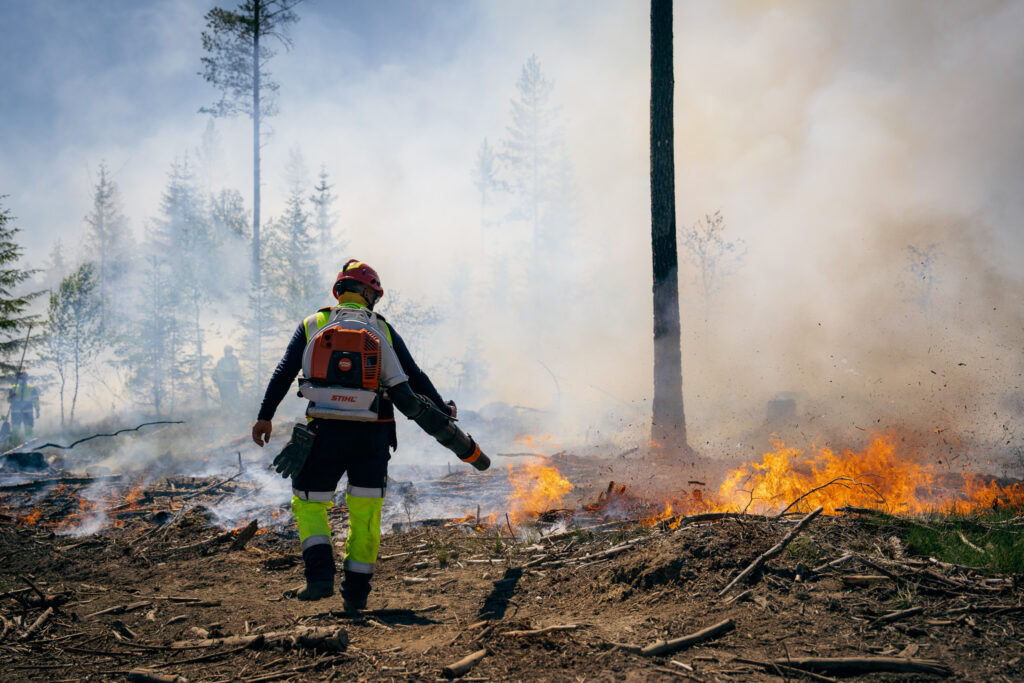
Norwegian fire and rescue services manage local incidents effectively. However, during large or concurrent crises, it may be unclear how resources should be shared between regions. Decisions are often based on manual assessments of local capacity and risk. In such situations, it can be difficult to obtain an overall view of both risk and available resources across regions.
About BRACE
BRACE is a collaboration between research institutions, fire and rescue services, public authorities and industry. The project aims to develop a national framework for decision support related to resource sharing between emergency services.
The framework will provide an objective assessment of the local resource situation based on short-term forecasts of natural hazard risk, and support collaboration when there is a need to share personnel, equipment and other resources.
The project is developing a prototype that demonstrates how such a system can function in practice. The work builds on close collaboration with fire and rescue services and focuses in particular on incidents related to forest fires and landslides.
BRACE will result in a shared situational understanding, estimates of local resource balance for day-to-day planning, and a framework for fair resource sharing between fire services.
Preparedness during large natural hazard events
Natural hazard events such as forest fires and landslides can require substantial resources within a short period of time. There is also a risk that several incidents occur simultaneously, particularly during periods of elevated wildfire risk. When this happens, emergency services must quickly assess whether they can deploy resources to other regions without compromising their own preparedness.
Today, there is no common method for making such assessments. Decisions are often made locally, based on experience and manual evaluations of available resources. This can make it hard to prioritise resources in an objective and coordinated way.
For local fire services, sharing resources can involve significant risk. When personnel or equipment are sent elsewhere, fire chiefs must also assess whether local preparedness remains sufficient should an incident occur. These decisions are often made under time pressure and with limited information.
During the forest fires in Sweden in 2018, several Norwegian fire services had to assess whether they could provide assistance across the border while maintaining preparedness in their own municipalities. The situation illustrates how challenging such decisions can be in the absence of clear national guidelines for resource prioritisation.
A shared framework can contribute to:
- a shared situational understanding and common terminology
- more holistic prioritisation of resources
- more efficient resource sharing between regions
- strengthened cooperation between emergency services during large and concurrent incidents
Methods and focus areas
BRACE applies a range of methods, including risk modelling and estimation of resource balance, in addition to qualitative approaches such as in-depth interviews with key stakeholders in fire and rescue services.
The risk model combines the likelihood of natural hazards with their potential consequences at local level, and can simulate incidents within a short time frame. Initially, the model focuses on risks connected to forest fires and landslides, but it can later be extended to include other types of risk.
Risk assessments are linked to data on available resources in fire and rescue services. This enables forecasts of local resource balance up to three days ahead, and helps identify situations where additional resources may be required.
Decision support for resource sharing
Based on the models, BRACE develops practical guidelines for how resources can be shared between municipalities and regions in a fair and objective way.
The project also develops a resource alert system to support local planning and communication between emergency services and other public authorities. This contributes to a shared situational understanding grounded in natural hazard risk.
Together with a common framework and shared terminology for assessing resources, this can strengthen national preparedness and support more effective coordination during crises across Norway.
To learn more about BRACE, get in touch.
Project: Balancing Resources Anticipating Compound Events (BRACE)
Partners: The Norwegian Fire and Rescue Academy, The Norwegian Directorate for Civil Protection, the County Governor of Østfold, Buskerud, Oslo and Akershus, Skred AS, Linköping University, Follo brannvesen, Nedre Romerike brann- og redningsvesen, Lesja og Dovre brannvesen, Øvre Romerike brann og redning, Oslo brann- og redningsetat, Trøndelag brann- og redningstjeneste, Bergen brannvesen
Funding: The Research Council of Norway
Period: 2025 – 2028